
Berkeley Farmers’ Markets
Fighting the good fight to keep recycling honest and beneficial
Published July 24, 2026 · Written by sachiko-omo-hanks
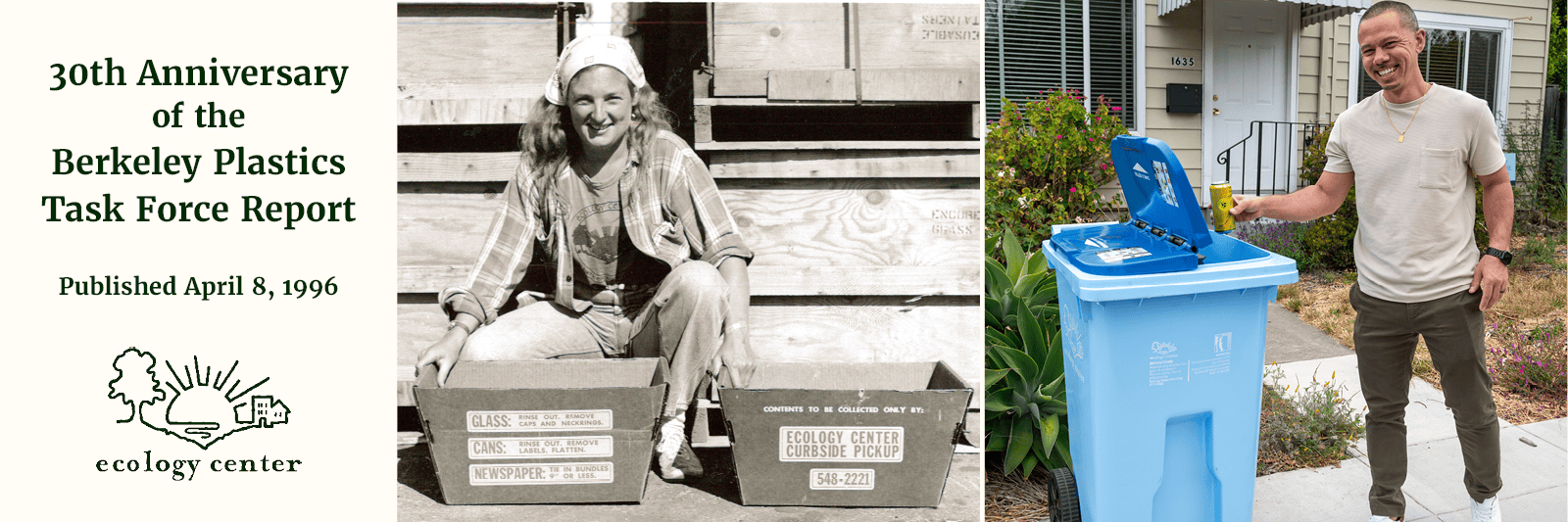
This year marks the 30th anniversary of The Report of the Berkeley Plastics Task Force, a multi-organizational group of experts convened by the Ecology Center in 1996, to research plastic recycling in depth.
The report found many fallacies in the statements by the oil and gas and plastic industry that dramatically overstated the potential to recycle plastic packaging. We found out years later that the industry knew this all along and lied about it anyway. This study became a foundational reference for considering plastic recycling and framed the core issues that would drive debate about plastic production and waste for years to come.
The report has been cited in class action suits about truth in advertising of the recyclability of plastics, included in other reports like the Center for Climate Integrity’s “The Fraud of Plastic Recycling,” and listed in educational materials by the Science History Institute. It has informed the Ecology Center’s approach and perspective on plastic recycling, and remains as relevant today as ever.
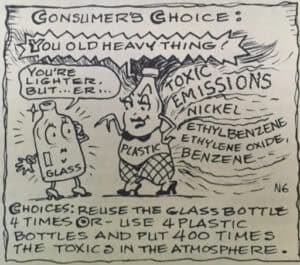
Looking back, the Ecology Center was always suspicious of industry claims about recycling. As the inventors of curbside recycling in 1973, we had to confront industry greenwashing from go. Keep America Beautiful, an industry-funded astroturf organization, had already released the famous “Crying Indian” ad, very successfully placing the blame for litter and pollution at the feet of unscrupulous consumers rather than revealing corporate decisions as the source of this trash and pollution.
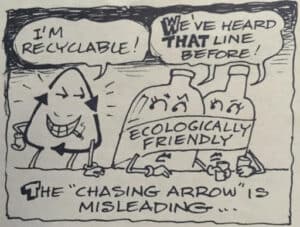 By the mid-1980s, the Ecology Center was fighting to keep the glass bottle refill system in place as industry sought to scale up and eliminate local refill infrastructure and replace it with a linear downcycling system whereby plastic bottles could be captured and made into long-cycle durable goods like carpet, furniture, and clothing. We lost that battle, but we keep up the fight to re-establish refill as the better solution and to improve on the bottle deposit system to keep bottles and cans out of our environment.
In the 1990’s, industry was really pushing the idea that all plastic is recyclable and that curbside programs should collect it all so that people could “do the right thing” and recycle it. This ongoing narrative that people are the source of the problem and they need help to behave right, completely ignored industry profit-driven decisions to switch to plastic packaging. They actively pushed cities all around us to “collect all plastic.” They claimed that if you collected enough of it, you would get more of the actually downcyclable packaging so that eventually markets would develop for the rest.
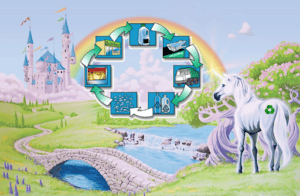 The large corporate garbage companies doing recycling for most California companies were more than happy to oblige. They were already moving towards “Single Stream” collection, which made recycling more convenient and reduced labor and operational costs. But it produced much lower grade materials. This combination of mixing everything in one bin and adding lots of new plastic formats made packers, consumers, and cities happy. But single stream collection was based on a mythology that it was all getting sorted in some land of rainbows and unicorns. The truth was much darker and grittier.
The Berkeley Plastic Task Force was established to study plastic recycling with the support of the Berkeley City Council. The findings were clear—Only narrow neck bottles and jugs (#1 and #2) had any hope of being made into something new. The rest had speculative, inconsistent markets, if any, and were often dumped or burned. Berkeley added #1 and #2 bottles and jugs to its collection and processing programs in 2000, nearly a decade after most other programs began accepting them. But we held off on all other plastic packaging for another 13 years.
By 2010, most California recycling programs were accepting all plastics, and there were pretty consistent, albeit low-value, markets overseas. We came under pressure from the City Council to conform to regional norms. While there were no US markets for those materials, Community Conservation Center (CCC)—who sorts, bales, and sells Berkeley’s recyclables—found a market in China for those mixed rigid plastic container (#3–#7) materials, at a plastic recycling factory that met basic environmental and labor standards. We commissioned the WuHu Ecology Center in China to evaluate the site, which found the factory had basic water filtration, emissions controls, proper disposal records, strong labor practices, and documented markets for their recycled plastic feedstocks. While this plant would never have been permitted in California, it was far better than the informal market and did meet our baseline requirements.
By 2015, China was importing massive amounts of mixed plastic packaging to informal markets with cheap family labor and no environmental controls. People sorted through it in backyard and small-scale operations, selling anything of value and dumping and burning the rest. This resulted in the release of toxic smoke, surface water pollution, groundwater contamination, and high levels of cancer, reproductive problems, chronic headaches, and other individual and community health concerns. By 2016, Berkeley’s market had stopped buying these low grades of mixed plastic, and the prices had become negative, meaning exporters were having to pay to get rid of it. This created all kinds of bad incentives for buyers to get paid to take the material and dispose of it in the worst ways—selling it for low-grade fuel for cement kilns or simply dumping it wherever they can.
Out of concern for what was happening with these mixed plastic bales, the Ecology Center put GPS trackers in outgoing bales to track them overseas. We commissioned partners through an international network, the Berkeley-based Global Anti-Incinerator Alliance (GAIA), a former fiscally sponsored project of the Ecology Center, to see what kinds of facilities were processing that material. What we found was very disturbing: chippers that generate microplastics, unprocessed wash water discharged into streams where local people wash and fish, dumping in agricultural fields, and open burning of piles of waste when they got too big. As a result, Berkeley stopped exporting mixed plastics and began to send it once again to our local landfill, where we could know exactly what was happening with it and where we knew we were not exporting harm to other communities.
Finally, in 2017 China adopted a wide range of environmental regulations called Blue Sky, including a complete prohibition of imports of any mixed plastic scrap called “National Sword.” Quickly, exporters found new informal markets in Southeast Asian nations like Malaysia, Indonesia, Thailand, and Vietnam. But those countries quickly cracked down and followed China’s lead. Finally, by 2018, the export of these grades stopped being exported on that scale and while new markets have emerged in Mexico and elsewhere, California recyclers massively reduced the export of this plastic trash and began to send it to local landfills once again.
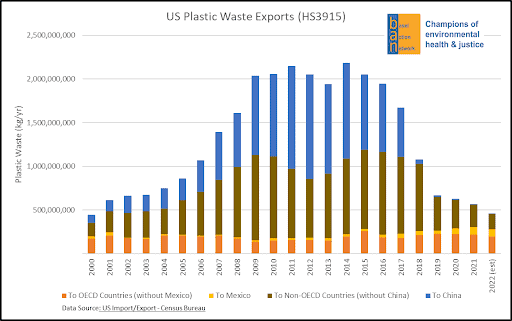 It was a disastrous decade and a black mark on California recycling that added to the global plastic pollution crisis and degraded confidence in recycling writ large. But the Ecology Center stayed true to its values, and locked arms with other non-profit recyclers to found the Alliance for Mission-Based Recycling (AMBR). Through this Alliance, we are able to amplify our voice and educate movement dialogues, politicians, and regulators on real recycling true to its original values.
AMBR is working to keep our local recycling programs as models for the industry, ensure that new statewide policies don’t undermine true recycling under new industry pressures, and support the creation of global regulations to address the export and transnational movement of plastic scrap. We are pushing for strong national Responsible End Market (REM) regulations and to prevent new plastic packaging types from contaminating our high-grade recycled paper. Current industry efforts to call pouches, wrappers, and film packaging “widely recyclable” will be disastrous for California’s paper markets, as they are nearly impossible to keep separate and get burned and dumped at international paper mills. Berkeley stands at the forefront of this battle by continuing its dual-stream, split-cart collection program and by holding the line on what it will and won’t add to the blue bin.
California’s SB54 and other state Extended Producer Responsibility laws like it put new requirements on producers to improve their packaging and pay for its end-of-life. While intended to finally move the responsibility from consumers back to producers, they can easily end up being mechanisms that enable the status quo as long as consumer brands pay to nominally “recycle” their packaging. This can be another perverse incentive for poor and/or false recycling schemes. Both industry and environmentalists have sued California over the enforcement of this law. And while it is required to go live next year, there is still a lot to battle over. Current fights are over the Responsible End Markets requirements, how payments will be made and to whom, and how currently non-recyclable items like cartons, pouches, wrappers, films, and small format packaging will meet the recycling requirements.
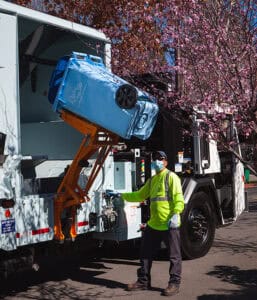
We are there for you, engaging in this dialogue, fighting the good fight to keep recycling honest and beneficial.
Berkeley is unique in having a community-based, non-profit, environmental leader run its recycling collections. We are honored and grateful to have your trust, and we take this responsibility very seriously. We work hard every day to ensure our services are always effective, transparent, honest, principled, cost-effective, responsive, and community-oriented.
